Your Substitute Should Not Have to Guess
How to Create Better Sub Plans
The beginning of a new school year may seem too early to think about substitute plans. You are still learning students’ names, teaching procedures, adjusting the schedule, and figuring out what works for your class. However, this is one of the best times to begin creating them.
You may not expect to need a substitute anytime soon, but absences are not always planned. Illnesses, family emergencies, appointments, meetings, and professional development can pull you away from your classroom with very little notice. Having a basic plan prepared now can save you from trying to explain your entire school day while you are sick, overwhelmed, or dealing with an emergency.
Your plans do not have to be extremely detailed at the beginning of the year. Start with what you know. As your classroom routines become more established, continue adding information until someone unfamiliar with your classroom can guide students through the day without having to guess what should happen next.
A Look Back at My Own Sub Plans
I recently reviewed sub plans that I used during the 2018–2019 school year. The first plan began as a January document. I later cloned and updated it for an absence in March rather than creating a completely new plan.
At the time, I taught fourth grade as part of a departmentalized team. Students switched classrooms for different subjects and used lockers to store their books and belongings. My sub plans needed to explain not only what students would be learning, but also when classes switched, which group should be in my room, when students went to their lockers, and how devices and materials moved between classes.
The plan mapped out nearly every part of the school day. It began with morning hall duty and continued through afternoon dismissal. There was an explanation of when students were released from the cafeteria, where they went before entering the classroom, when they could use the restroom, and what time the classroom door should open.
It also included instructions for lunch choices, attendance, pencil sharpening, device distribution, class changes, specials, recess, lunch, intervention time, locker visits, and dismissal.
At first glance, that might sound like an excessive amount of information. However, each detail served a purpose. A substitute was entering a classroom with established systems but without the benefit of watching those systems develop. The plan gave the substitute access to information that my students and I already understood.
A Schedule Is Not the Same as a Sub Plan
A classroom schedule might tell a substitute that English language arts begins at 8:00 and social studies begins at 9:30. That does not explain what students should do, where materials are located, who distributes them, how transitions should happen, or what must be completed before the next subject begins.
In a departmentalized classroom, a basic schedule also may not explain which class is arriving, where your homeroom is going, or which teacher is responsible for each group during a transition.
My plan provided specific times, but it also explained what happened during each part of the day. For example, it did not simply say that students arrived in the morning. It explained that they went to their lockers after being released from the cafeteria, lined up at the classroom door with their books, and used the restroom before entering. It also told the substitute when students could enter the classroom.
That information helped preserve the morning routine and reduced opportunities for confusion and misbehavior. It allowed the substitute to begin the day with clear expectations instead of trying to reconstruct the routine by questioning students.
Explain the Routines That Hold the Day Together
Some classroom routines may seem too small to include in a sub plan, but those small routines often prevent larger problems.
In my classroom, pencils were sharpened only during the morning arrival period. Two designated students handled that responsibility, and the pencil sharpener was not used after 8:00.
Including that information helped prevent students from getting up throughout the day, interrupting instruction, or telling the substitute that they were normally allowed to sharpen pencils whenever they wanted. The procedure was simple, but it supported classroom management.
Think about the routines that keep your classroom running. When can students sharpen pencils? How do they request a restroom break? Where do they turn in assignments? What should they do when they finish early? How are materials distributed and collected?
These procedures may be automatic for you and your students, but they will not be automatic for a substitute.
Identify Student Helpers Without Putting Them in Charge
My plan identified students who could assist with familiar classroom responsibilities. Designated helpers handled lunch choices, sharpened pencils, distributed devices, collected laptops, and passed out car-rider tags.
This was useful because the students already knew how to complete those jobs. The substitute did not have to learn every procedure alone, and the class could continue using its established routines.
Student helpers should support the substitute, but they should not be placed in charge of the classroom or responsible for disciplining their classmates. Assign dependable students specific, limited responsibilities. It is also helpful to identify an alternate in case the regular helper is absent.
Organize the Materials a Substitute May Need
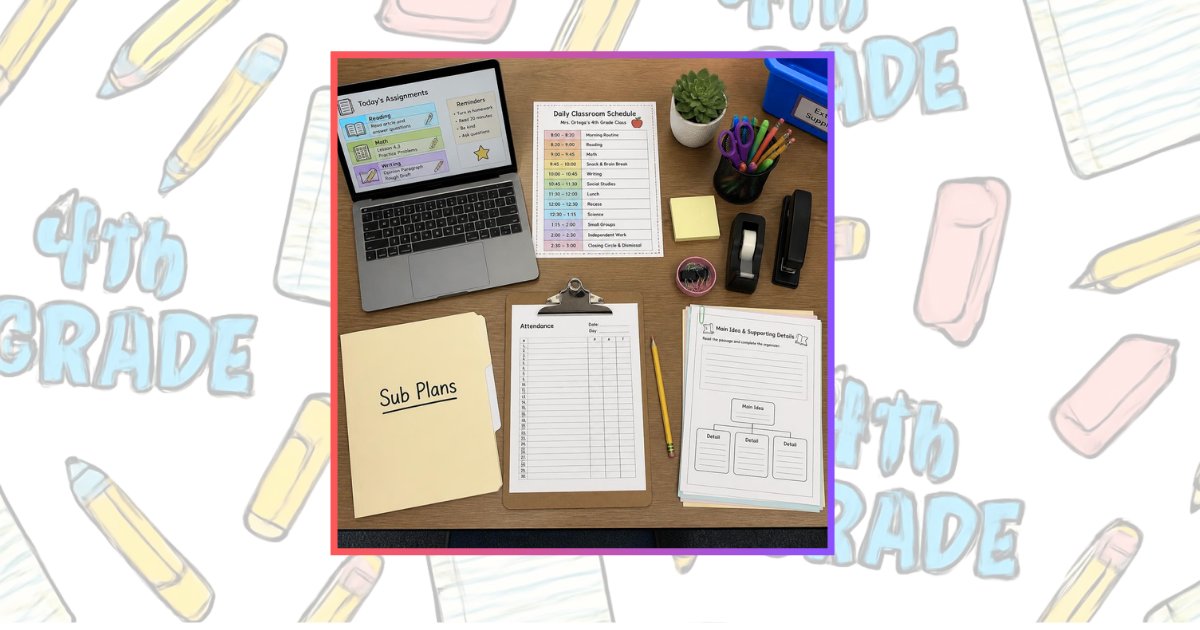
I typically maintained a folder containing important forms and documents. That folder was kept with or inside my substitute tub, which also held printable activities and worksheets that could be used when needed.
The exact arrangement varied depending on the day and the assignments I had prepared. If students were completing printed work, those materials might be waiting in the tub. If the day relied primarily on digital assignments, the substitute might need only the forms, class information, and backup materials.
In the earlier plan, I directed the substitute to find the lunch form and attendance roster in a yellow folder inside a blue tub on my desk. In the May plan, I placed a substitute folder directly on the desk with the lunch form, roster, and other important information.
This does not mean that I stopped using the tub. It shows that the location and arrangement of the materials changed based on what the substitute needed for that particular absence.
A substitute should not have to search through drawers, cabinets, and stacks of paper while also supervising students. Whether you use a folder, binder, tub, or a combination of these, tell the substitute exactly where the materials are located.
A folder works well for schedules, rosters, forms, contact information, and other documents. A tub can hold worksheets, printed activities, books, manipulatives, and backup assignments. The most important consideration is not the container itself. It is whether the substitute can quickly find and understand what has been provided.
Provide Clear Instructions for Technology
My plans explained which students would distribute the laptops, what assignments needed to be completed, where those assignments were posted, and how many devices should be returned.
The device count was especially important. It gave the substitute a way to confirm that every laptop had been collected. The plan also explained when the devices needed to be placed in the charging cart and when they should remain available because another class would need them.
In the later plan, the students’ To Do List was posted digitally in Google Classroom. They used that list to see which English language arts and social studies assignments they needed to complete. Because the students were familiar with Google Classroom and the To Do List procedure, the plan could direct them back to an established digital routine.
If students use technology, include more than the name of the website or program. Explain how students access the assignment, what they should complete, what they should do if they cannot log in, where devices should be returned, and whether the devices need to be charged.
Even when the primary work is digital, it is helpful to keep printed backup activities in the substitute tub. Technology can fail, devices may be unavailable, or a student may have difficulty accessing an account.
Keep Academic Expectations Clear
My plans told the substitute what students needed to complete for English language arts and social studies. In the later plan, the digital To Do List in Google Classroom served as the central source for the day’s assignments.
The substitute was asked to read the assignment list to students, direct them to the copy in Google Classroom, and remind them that the work would be graded. This communicated that the day still mattered even though their regular teacher was absent.
Substitute work should be meaningful, familiar, and manageable. A day with a substitute is usually not the best time to introduce a complicated new skill that requires extensive direct instruction. Students should be able to complete the assignment using routines and resources they have already practiced.
Be specific about what must be finished, what may be continued later, and what students should do if they complete the required work early.
Account for Class Changes
Because I taught on a departmentalized fourth-grade team, the substitute needed to know when my homeroom left, when another class arrived, which teacher was receiving my students, and whether both groups were completing the same assignments.
My plan identified the class-switching times and explained which students could distribute and collect devices for each group. It also told the substitute when my homeroom would return.
These details helped the substitute prepare for each class and prevented confusion about which students were supposed to be in the room.
If your students switch classes, include the names or roles of the teachers involved, the subjects taught in each room, the transition times, the groups the substitute will supervise, and any differences between their assignments or procedures.
Do not assume the master schedule will provide all of that context.
Explain Transitions, Supervision, and Safety Expectations
Many classroom problems occur during transitions rather than during academic work. My plans included times and directions for switching classes, going to the restroom, walking to lockers, attending specials, eating lunch, returning from the cafeteria, and preparing for dismissal.
They also clearly stated that students should never be left unattended. During the afternoon locker visit, the substitute was instructed to walk with the students, monitor them in the hallway, keep them quiet, and prevent anyone from entering the classroom without an adult present.
Because the students had lockers, simply writing “locker break” would not have been enough. The plan explained how they should walk to the lockers, what they needed to retrieve, and how quickly they should return before dismissal began.
I included these directions to support the substitute, not to micromanage.They addressed known supervision concerns and explained how the routine helped prevent missing items and misbehavior.
When creating your own plan, think beyond what students will be learning. Consider where they will be throughout the day, who is responsible for them, and what the substitute needs to know to move them safely from one location to another.
Do Not Assume Dismissal Will Explain Itself
Dismissal can be one of the most confusing and safety-sensitive parts of the school day. My plans explained when students should prepare, where car-rider tags were located, how the school’s bus parade worked, when daycare riders would leave, which students needed to be escorted to the car-rider area, and whether I had an assigned dismissal duty that week.
A substitute who is unfamiliar with your school may not understand terms that everyone else uses daily. If your school has a bus parade, color-coded dismissal groups, daycare vans, walker procedures, sibling pickup, or assigned duty stations, explain those procedures clearly.
Include a current dismissal list and make it clear that unexpected transportation changes must be confirmed through the office. This information should be reviewed whenever a student’s transportation changes.
Give the Substitute Trusted Adults to Contact
At the end of my plans, I identified my teammate and other teachers on my grade level as people who could answer questions or assist with concerns.
This was particularly important in a departmentalized setting because those teachers understood the class switches, shared students, assignments, and grade-level schedule.
The names changed between the earlier and later plans based on who was available that day. The May plan also noted that another teacher would be taking my teammate’s place.
Instead of guessing or relying entirely on students, the substitute knew which adults understood the schedule and classroom procedures.
Identify at least one nearby teacher who can help. You may also want to include the appropriate extensions for the front office, nurse, or another school contact. Confirm that the people listed in the plan know that a substitute may come to them for assistance.
Include the Classroom Behavior System
The May plan included an important addition that did not appear in the same level of detail in the earlier version. I left a behavior clipboard on my desk and explained how the substitute could use it.
The clipboard included a color-coded behavior record with student names and codes for documenting specific behaviors. Another sheet reflected consequences connected to upcoming class activities. My lesson plan instructed the substitute to warn the student, explain that the student was in danger of losing a privilege, and follow through if the behavior continued.
Including the established behavior system gave the substitute a structured response to misconduct. The substitute did not have to invent consequences, negotiate expectations, or depend on students to explain what normally happened.
Any behavior instructions should be consistent with current school and district policies. The system should be clear enough for a substitute to understand and apply fairly.
Ask for an End-of-Day Note
My final request was simple: “Please leave me a note to let me know how your day went.”
A substitute report tells you which assignments students completed, which students were especially helpful, whether behavior concerns arose, and which parts of the plan were unclear. That information can help you address problems when you return and improve your plans before your next absence.
Consider leaving a simple form with space for attendance updates, completed work, unfinished work, behavior notes, schedule changes, and questions.
How My Sub Plan Changed During the School Year
Comparing the earlier plan with the May version helped me see how much the document had evolved. The basic structure remained, but the later plan reflected changes in student independence, classroom routines, materials, staffing, behavior procedures, special events, and dismissal responsibilities.
| Area | Earlier plan | May plan | Why the change mattered |
|---|---|---|---|
| Essential forms | The substitute was directed to a folder inside the sub tub | A substitute folder was placed directly on the desk | Frequently needed forms became faster to locate |
| Printed materials | The sub tub could hold worksheets and other printable activities | Most assigned work was digital, with printed materials available if needed | The materials reflected how students would work that day |
| Student helpers | Specific students were named throughout the schedule | Helper names were supplemented by a separate letter in the substitute folder | Helpers could be updated without rewriting the entire plan |
| Assignments | The plan provided directions for the work assigned that day | Students followed a digital To Do List posted in Google Classroom | The plan used a routine students already understood |
| Staff coverage | The regular teammate was identified | The plan noted that another teacher would be covering the teammate’s class | The substitute knew who was actually working that day |
| Behavior | General supervision expectations were provided | A behavior clipboard, documentation codes, warnings, and consequences were explained | The substitute could use an established classroom system |
| Special events | The schedule followed a regular instructional day | Movie Day and snack distribution instructions were added | The plan reflected events taking place on that particular day |
| Dismissal | Car-rider duty was assigned | The plan stated that there was no car-rider duty that week | Dismissal responsibilities were kept current |
| Support contacts | One set of grade-level contacts was listed | The available support contacts were revised | The substitute knew which adults were available to help |
The differences show why an old plan should never be printed and reused without reviewing it. Staff coverage, specials, duties, transportation arrangements, student helpers, assignments, and school events can change.
The comparison also shows that I did not recreate my sub plans from the beginning every time I needed one. I developed a foundation, cloned it, updated the day-specific information, and improved the document as I learned what another person needed to manage the classroom successfully.
That is a practical system any teacher can use.
Start General, Then Build
If you are a new teacher or beginning a new school year, your first plan may not be as detailed as the plans I was using later in the year. That is understandable. Your procedures may still be changing, and you may not yet know which students can be trusted with classroom responsibilities.
Begin with the information you have now:
- The daily schedule
- Arrival and dismissal procedures
- Attendance and lunch instructions
- Classroom rules and essential routines
- Emergency and safety procedures
- Necessary student support information
- Names or roles of nearby staff members who can help
- Familiar assignments students can complete with limited assistance
- A backup activity that does not require technology
- A place for the substitute to leave notes
Return to the plan as the year progresses. Add the routines that become consistent. Update student helpers, class rosters, student supports, technology instructions, transportation information, and staff contacts. Remove anything that is no longer accurate.
Each time a substitute uses the plan, consider what worked and what was missing. If the substitute had trouble locating a form, label it more clearly. Do transitions cause confusion that can be remedied by adding clearer directions? If student responsibilities changed, update the helpers. If your classroom behavior system became more established, explain how the substitute should use it.
Your sub plan should be treated as a working document, not something you create once and forget.
Detailed Plans Benefit Everyone
Detailed plans reduce uncertainty for the substitute, help students maintain their regular routines, and make it more likely that meaningful learning will continue while you are away. They also reduce the number of decisions a substitute must make while supervising unfamiliar groups of students.
Most importantly, preparing your plans protects your peace. If you wake up sick or have an emergency, you should not have to write an entire day of instructions before you can take care of yourself.
You do not need to create the perfect sub plan during the first weeks of school. Create the best version you can with the information you have now. Then continue building it until it reflects how your classroom actually works.
A substitute should not be expected to read your mind, and your students should not be responsible for explaining the entire school day. A clear, current plan gives everyone a better chance of having a safe and productive day, including you.
Review the Complete Plans
Would you like to see how the complete plan changed over the course of the school year? I have placed the two versions together so you can review the schedule, procedures, classroom responsibilities, and additions that appeared in the later plan.
PDF, 7 pages, 546 KB. Opens in a new tab.
As you compare them, consider what information someone would need to step into your classroom tomorrow. Your first version does not have to contain everything. It simply needs to give you a reliable place to begin.