When Sunday Night Dread Starts Ruining a Teacher’s Weekend
There was a time when I looked forward to the weekend all week long, but not because I had exciting plans, was traveling, or had set aside time for myself. I looked forward to it because I needed it.
I needed the rest.
Or at least I hoped I would get some.
When the Work Followed Me Home
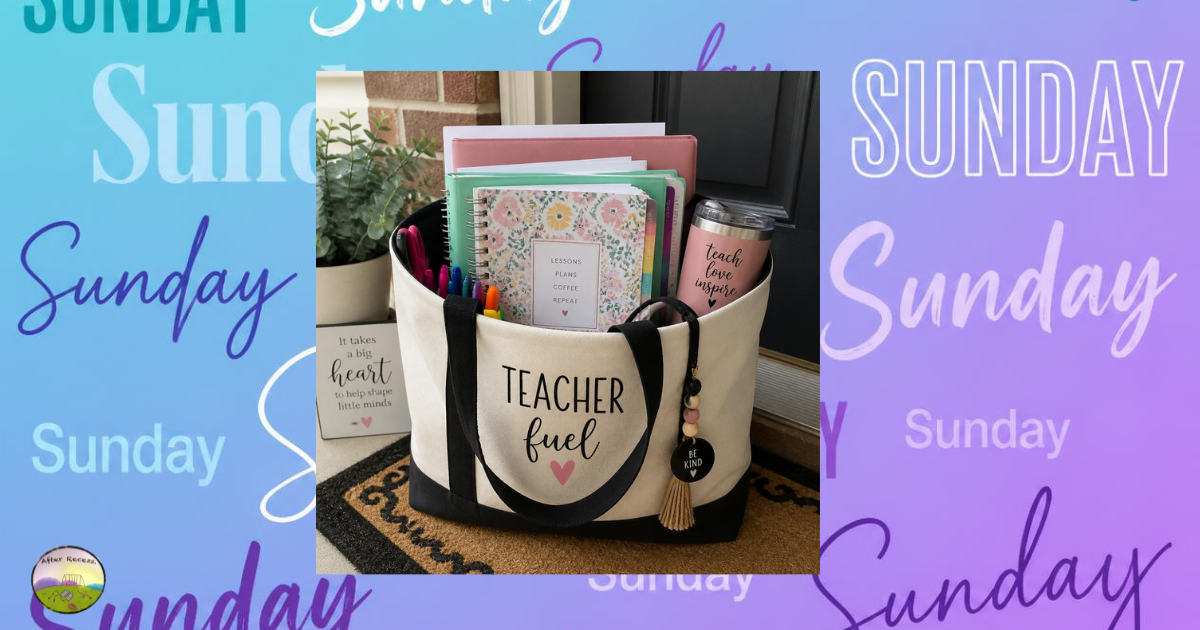
Every Friday, I would leave school carrying one or more teacher tote bags stuffed with papers to grade, notebooks, journals, lesson materials, sticky notes, and scraps of paper with reminders scribbled across them. Each bag represented work I hadn’t finished. Every bag represented a promise I made to myself.
“This weekend, I’ll catch up.”
Of course, I rarely did.
Saturday was usually reserved for my family. I wanted to be present and to enjoy my husband and my son. I wanted to do normal weekend things without feeling guilty about them.
Then Sunday would arrive.
The work was still sitting in those bags.
The papers were still ungraded.
The plans were still unfinished.
The sticky notes were still waiting.
And suddenly, what was supposed to be a day of rest became a race against Monday.
I would procrastinate all day, knowing exactly what needed to be done and dreading every minute of it. The longer I waited, the more anxious I became. The more anxious I became, the longer I waited.
It was a cycle I knew well.
The frustrating part was that I wasn’t bringing work home because I was disorganized or lazy.
I was bringing work home because there often wasn’t enough time to finish it at school.
People love to talk about teacher planning periods as if they’re magical blocks of uninterrupted productivity.
Many teachers know better.
Sometimes my planning period disappeared into mandatory professional development.
Other times it became a team meeting.
Sometimes it was consumed by paperwork, parent communication, behavior documentation, or a dozen other urgent responsibilities.
And sometimes, if I’m being completely honest, I finally had my planning period and spent part of it talking with coworkers.
We’d debrief.
Catch up.
Vent.
Laugh.
Talk through difficult situations.
Or maybe I was the one who stopped by someone else’s room.
Before I knew it, the planning period was over and I hadn’t accomplished nearly what I intended to.
That’s what happens when human beings spend their days carrying enormous responsibilities. Sometimes connection feels more necessary than productivity.
The work, however, didn’t disappear.
It simply followed me home.
For years, those teacher bags traveled everywhere with me.
School.
Home.
Back to school.
Back home again.
Sometimes I worked through them.
Sometimes I didn’t.
Either way, they occupied space in my house and in my mind.
Then one day my husband met me at the door.
As I started bringing my bags inside, he stopped me. I thought he was coming to help me get them in the house.
He told me to put them back in the car.
At first, I was surprised.
But the more I thought about it, the more I realized he wasn’t really talking about the bags.
He had watched me carry those things around for years only to spend weekends working.
My husband had watched me spend weekends worrying about working.
He had watched me beat myself up when I wasn’t working.
The bags had become symbols of a burden that never seemed to leave.
For the most part, I listened to him.
The bags stayed in the car.
And while that didn’t solve every problem, it forced me to confront something I had been avoiding.
I needed boundaries.
Not because I didn’t care.
Because I cared too much.
The longer I taught, the more I realized that many educators are asked to carry workloads that quietly spill into every corner of their lives. We accept it because we care about students and because we want to do a good job. It is also accepted it because everyone around us seems to be doing the same thing.
Eventually, though, something happened that I couldn’t ignore.
When Sunday Night Dread for Teachers Starts Early
My Sunday night dread stopped waiting for Sunday.
One Friday evening around seven o’clock, I felt panic creeping in.
Friday.
The weekend had barely started.
And yet I was already anxious because Monday was getting closer.
I remember sitting with that realization and thinking, “This isn’t normal.”
I don’t mean normal in the sense that it was uncommon.
Unfortunately, I think many educators experience some version of this.
I mean normal in the sense that it shouldn’t be accepted as the cost of doing meaningful work.
Somewhere along the way, education developed a dangerous relationship with sacrifice.
Teachers are expected to sacrifice time.
Energy.
Peace.
Health.
Family moments.
Boundaries.
And if we’re not careful, we start believing that suffering is evidence of commitment.
I don’t believe that anymore.
Teaching requires dedication.
It requires effort.
It requires heart.
But I don’t think it should require losing yourself.
That’s why I take Sunday night dread seriously.
Not because it means someone should immediately quit teaching.
And not because every difficult season requires a dramatic life change.
But because it may be trying to tell us something.
Maybe it’s telling you that you need stronger boundaries.
You’re burned out.
It may be telling you that you need more support than you’re receiving.
It could be telling you that the environment you’re in is no longer healthy.
Or maybe it’s asking you a question you’ve been afraid to answer:
“Is it time for something different?”
Only you can answer that.
Some teachers find new life in a different school, grade level, role, or approach.
Others eventually discover that their next chapter exists outside the classroom.
Both paths are valid.
What isn’t healthy is convincing yourself that constant dread is simply part of the job.
Common Does Not Mean Normal
Looking back, I don’t think the teacher bags were ever the problem.
They were just visible evidence of something deeper.
The real issue was believing that my well-being mattered less than the work.
It did not.
And yours doesn’t matter less either.
Whether your next step is setting boundaries, seeking support, changing environments, or exploring an entirely new path, know this:
Sunday night dread may be common among educators.
But that doesn’t mean it has to be normal.
And it certainly doesn’t mean you have to accept it forever.
For me, that dread did not always wait until Sunday or even until the school year began. Eventually, July became a reminder that summer was ending and the classroom was waiting. I share more about that shift in When July Stopped Feeling Like Summer.